How to Choose a Manufacturer of Equipment for Juice Beverage Factories
Updated: 21 hours ago
Starting a juice beverage factory or expanding an existing beverage production business requires more than purchasing a filling machine. The success of a bottled juice beverage factory depends on selecting the right processing equipment, filling technology, packaging system and production capacity.
For investors and beverage manufacturers, choosing a reliable equipment manufacturer is one of the most important decisions in the factory development process. The right supplier should understand the beverage product, recommend a suitable production process, integrate the required machinery and help coordinate the complete production line.
But how do you compare different manufacturers? What equipment does a juice beverage factory actually need? And what should you consider before investing in a complete bottled juice beverage bottling line?
This guide explains the essential factors to consider when choosing a juice beverage filling production line manufacturer, from product requirements and machinery configuration to supplier evaluation and turnkey factory planning.
How to Choose a Manufacturer of Equipment for Juice Beverage Factories
1. Understand Your Juice Beverage Products Before Choosing Equipment
The first step is to determine exactly what beverages your factory will produce.
Different juice beverages have different formulations, ingredients, viscosity levels and processing requirements. A production line designed for a clear orange-flavored fruit drink may not be suitable for a beverage containing mango pulp or other suspended fruit particles without appropriate adjustments.
Common juice beverage products include:
Mango juice beverages
Orange juice beverages
Apple juice beverages
Peach juice beverages
Pineapple juice beverages
Grape juice beverages
Guava juice beverages
Passion fruit beverages
Lychee juice beverages
Coconut juice beverages
Mixed fruit beverages
These products may be manufactured using fruit juice concentrate, fruit puree, pulp, water, sugar, flavors and other ingredients according to the beverage formulation.
Before requesting a quotation, consider the following questions:
What type of beverage will you produce?
A clear fruit drink, a cloudy juice beverage and a pulp-containing mango drink may require different processing configurations.
Will you manufacture one product or several varieties?
A factory planning to produce mango, orange, apple and coconut beverages should consider product changeover, cleaning procedures, recipe management and equipment flexibility.
Does the beverage contain fruit pulp?
Pulp content and product viscosity can influence mixing, homogenization, product transfer and filling equipment selection.
A reliable juice beverage equipment manufacturer should evaluate these requirements before recommending a machinery configuration.
2. What Equipment Does a Juice Beverage Factory Need?
A complete juice beverage factory normally consists of several connected production systems. The exact configuration depends on the beverage formula, packaging format, production capacity and required level of automation.
The main equipment categories include:
Water Treatment System
Water is an important ingredient in many formulated juice beverages.
A water treatment system is selected according to the source water quality and the requirements of the final beverage. It may include filtration, purification and other treatment processes.
Ingredient Preparation and Mixing System
This section prepares the beverage before filling.
Typical equipment may include:
Ingredient preparation tanks
Sugar dissolving systems
Mixing tanks
Blending tanks
Product storage tanks
Transfer pumps
Filtration equipment
The mixing system should be designed around the beverage recipe, ingredient characteristics and production volume.
Homogenization and Thermal Processing Equipment
Depending on the product formulation, a juice beverage production process may require homogenization, pasteurization or other thermal treatment.
Homogenization can help achieve a more uniform product when the formulation requires it.
The thermal processing method must be selected according to the beverage formulation, acidity, packaging requirements and applicable food safety standards. Not every fruit beverage uses an identical treatment process.
Juice Beverage Filling and Packaging System
The filling section is one of the most important parts of a bottled juice beverage bottling line.
It may include:
Bottle rinsing equipment
Juice filling machines
Bottle capping machines
Can filling and seaming machines
Bottle conveyors
Labeling machines
Date coding equipment
Secondary packaging machines
The filling and packaging equipment must match the beverage characteristics and container specifications.
CIP Cleaning System
For beverage factories, cleaning is an important part of production management.
A Clean-in-Place (CIP) system can be configured to clean suitable product-contact equipment and pipelines without dismantling the entire system.
Its design should reflect the production process, equipment structure, cleaning requirements and factory hygiene procedures.
3. Choose the Right Bottled Juice Beverage Bottling Line
Packaging is a major factor in determining the configuration of a juice beverage filling production line.
A manufacturer should not recommend a filling machine without first understanding the container type, bottle dimensions, cap specifications and beverage characteristics.
Three common packaging options are PET bottles, glass bottles and beverage cans.
PET bottles are widely used for packaged fruit drinks because they offer flexibility in bottle size, shape and packaging design.
A PET juice beverage production line may include:
PET bottle blowing machine
Air conveyor
Bottle rinsing system
Juice filling machine
Bottle capping machine
Cooling system when required
Labeling machine
Date coding equipment
Film wrapping or carton packaging machine
For factories producing multiple bottle sizes, the equipment configuration should consider bottle changeover, mold requirements and packaging flexibility.
Glass bottles are another option for juice beverage manufacturers.
A glass bottle filling line may include bottle washing, rinsing, filling, capping, cooling, labeling and packaging equipment.
Glass containers require suitable bottle handling and conveying systems. Bottle dimensions, weight, cap type and production speed should all be considered during equipment selection.
For manufacturers planning to produce hot-filled fruit beverages or tea drinks, the filling and cooling process should be designed around the product and glass container specifications.
Canned juice beverages require a different packaging system from bottled products.
A typical canning line includes:
Can feeding or depalletizing equipment
Can rinsing equipment
Beverage filling machine
Can seaming machine
Cooling equipment when required
Coding system
Secondary packaging equipment
The can filling and seaming system must be matched to the can format, beverage properties and required production speed.
Important: PET bottles, glass bottles and cans are not interchangeable packaging options from an equipment perspective. Each requires appropriate container handling, filling and sealing technology.
4. How to Determine the Required Production Capacity
Production capacity is another major consideration when selecting juice beverage factories machinery in China.
A factory should select its production capacity according to expected market demand, sales forecasts, working hours, packaging sizes and future expansion plans.
For bottled beverages, production capacity is commonly expressed in bottles per hour (BPH).
For example, a beverage investor may compare production requirements such as:
Production target | Typical project consideration |
3,000 BPH | Smaller-scale or developing beverage operations |
6,000 BPH | Growing regional beverage production |
12,000 BPH | Higher-volume commercial production |
24,000 BPH | Large-scale beverage manufacturing |
36,000 BPH or above | High-capacity industrial production |
These are illustrative planning levels, not guaranteed machine specifications. Actual output depends on bottle size, beverage characteristics, filling technology, equipment configuration and operating conditions.
A manufacturer should also explain the difference between the rated speed of an individual filling machine and the practical output of the complete production line.
The final capacity is influenced by the performance of the entire system, including upstream processing, filling, capping, labeling, packaging and material handling.
When comparing quotations, make sure the proposed equipment capacities are properly matched.
5. How to Evaluate Bottled Juice Beverage Filling Machine Manufacturers
Choosing among different bottled juice beverage filling machine manufacturers requires more than comparing prices.
A reliable manufacturer should be able to demonstrate technical understanding, equipment integration capabilities and experience with relevant beverage applications.
Consider the following five factors.
1. Beverage Processing Experience
Does the manufacturer understand different juice beverage formulations?
Ask whether the proposed production system is suitable for clear fruit drinks, cloudy beverages, pulp-containing products or other formulations you plan to manufacture.
A supplier with relevant beverage processing experience can help identify equipment requirements before the project reaches the installation stage.
2. Complete Production Line Integration
A juice beverage factory needs more than a standalone filling machine.
Check whether the supplier can coordinate water treatment, ingredient preparation, mixing, thermal processing, filling, capping, labeling and packaging equipment.
Integrated equipment configuration is particularly important for new factories that do not have an existing production system.
3. Packaging Options
Check whether the manufacturer can provide equipment for your intended packaging format.
For example, a PET bottle project may require bottle blowing, rinsing, filling and capping equipment, while a glass bottle or can project requires different handling and sealing systems.
If you plan to introduce additional packaging formats in the future, discuss the technical and investment implications in advance.
4. Factory Planning and Engineering Capability
For a new juice beverage factory, equipment selection should be connected to the factory layout.
A suitable manufacturer should be able to review production space, equipment arrangement, material flow, utilities and installation requirements.
This helps reduce the risk of purchasing machinery that does not fit the actual factory conditions.
5. Installation, Commissioning and Technical Support
Before placing an order, clarify the scope of installation guidance, commissioning, operator training, technical documentation, spare parts and after-sales support.
These details are especially important for international buyers purchasing machinery from China.
6. Why Consider a Complete Turnkey Juice Beverage Production Line?
Some investors purchase individual machines from different suppliers. This approach may be appropriate for factories with existing engineering teams and established production systems.
However, for a new beverage factory, purchasing a complete turnkey production line can simplify project coordination.
A turnkey solution can bring together:
Water treatment
Beverage preparation
Mixing and blending
Homogenization when required
Thermal processing
Storage and transfer systems
Bottle blowing when required
Filling and capping
Labeling and coding
Secondary packaging
Conveying and material handling
The main advantage is that the production system can be planned as one integrated project rather than a collection of unrelated machines.
A complete solution also allows the buyer to discuss equipment capacity, factory layout, packaging specifications and production requirements with a coordinated engineering team.
However, turnkey does not mean every factory needs the same equipment. A suitable configuration should always be based on the actual product and project scope.
7. Why Work with a Juice Beverage Factory Equipment Supplier in China?
China has an established industrial supply chain for beverage filling and packaging machinery.
For international beverage investors, working with a Chinese equipment manufacturer can provide access to different machinery categories, packaging technologies and customized production line configurations.
However, buyers should evaluate each supplier carefully rather than assuming that all manufacturers offer the same engineering capabilities.
When comparing juice beverage factory equipment suppliers in China, consider:
Whether the company has relevant beverage production line experience
Whether it can provide equipment for your chosen packaging format
Whether it understands the processing requirements of your beverage
Whether the equipment configuration matches your target capacity
Whether factory layout and installation requirements are considered
Whether technical support and spare parts arrangements are clearly explained
Whether the quotation specifies the equipment scope and exclusions
For international projects, also clarify shipping arrangements, destination-country requirements, installation responsibilities and the documentation needed for equipment importation.
The best supplier is not necessarily the one offering the lowest initial quotation. It is the one whose proposed production system fits your actual manufacturing requirements and long-term business plan.
8. How LiDLi Supports Juice Beverage Factory Projects
LiDLi Machinery provides juice beverage production and filling solutions for investors and manufacturers planning new beverage factories or upgrading existing production facilities.
Its juice production line options cover different packaging formats, including:
PET bottle juice filling lines
PET bottle juice with pulp filling lines
Glass bottle juice filling lines
Glass bottle juice with pulp filling lines
Can juice filling lines
Depending on the project, the equipment scope can be coordinated with beverage processing, bottle blowing, filling, capping, labeling, packaging and other production systems.
LiDLi also provides turnkey project support covering product and bottle design, factory layout planning, equipment configuration, installation and commissioning.
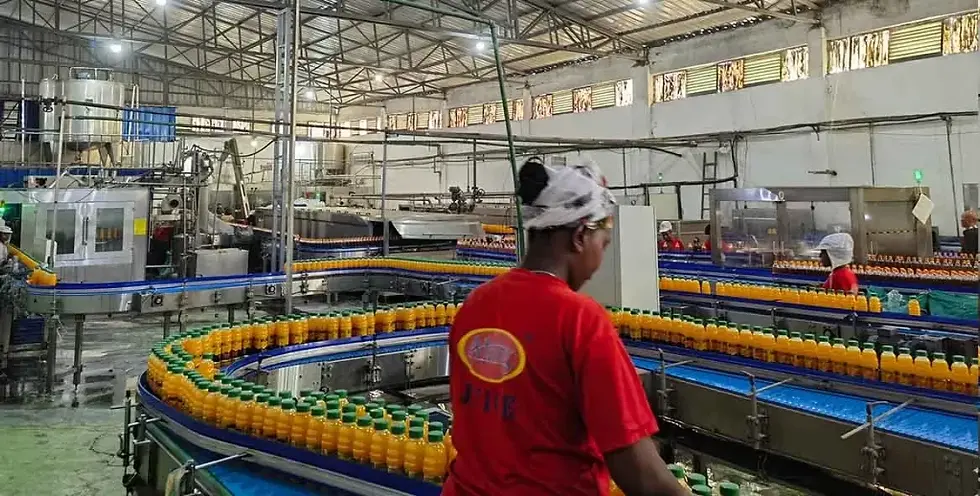
For example, one of the company's displayed project references is a mango juice production line in Ethiopia, with a stated capacity of 24,000 bottles per hour for 600 ml and 2 L packaging.
This illustrates why equipment selection should be connected to the customer's beverage products and packaging requirements rather than based only on a standard machine catalog.
For investors planning to produce mango, orange, apple, coconut or mixed fruit beverages, the first step is to define the product formulation and packaging specifications. The machinery configuration can then be developed around the actual production target.
9. Information to Prepare Before Requesting a Juice Production Line Quotation
Providing complete project information helps a manufacturer recommend a more suitable production system.
Before contacting a supplier, prepare the following details:
Project information | What to provide |
Beverage type | Mango, orange, apple, coconut or mixed fruit beverage |
Product formulation | Clear, cloudy, pulp-containing or other formulation |
Packaging format | PET bottle, glass bottle or can |
Container size | 250 ml, 350 ml, 500 ml, 1 L or other sizes |
Production capacity | Required bottles or cans per hour |
Filling process | Hot filling or another suitable process |
Product range | One beverage or multiple beverage varieties |
Automation level | Semi-automatic, automatic or fully automatic |
Factory location | Country and project location |
Project status | New factory, expansion or equipment replacement |
If you do not have all the technical details yet, you can still begin with your intended beverage products, packaging format and approximate production target.
An experienced manufacturer can review the available information and help identify the next technical decisions.
Frequently Asked Questions
What is a juice beverage filling production line?
A juice beverage filling production line is an integrated system that prepares, processes and fills formulated fruit beverages into PET bottles, glass bottles or cans. Depending on the product, it may include water treatment, ingredient mixing, homogenization, thermal processing, filling, sealing, labeling and packaging equipment.
What equipment is required for a bottled juice beverage factory?
A bottled juice beverage factory may require water treatment equipment, ingredient preparation tanks, mixing systems, thermal processing equipment, storage tanks, bottle blowing machines, rinsing and filling machines, capping machines, labeling machines and packaging equipment. The final configuration depends on the beverage formulation, packaging format and production capacity.
Can one juice beverage production line produce mango, orange and apple beverages?
Yes, a suitably designed production line may support multiple fruit beverage varieties. However, product changeover, recipe management, cleaning procedures, viscosity, pulp content and thermal processing requirements must be considered. Some products may require additional equipment or different processing configurations.
What is the difference between PET, glass bottle and can juice filling lines?
PET bottle lines use bottle handling, rinsing, filling and capping equipment. Glass bottle lines require suitable bottle washing and handling systems, while canning lines use can filling and seaming equipment. Each packaging format needs a configuration designed for its container and product requirements.
How do I choose a bottled juice beverage factory equipment supplier?
Evaluate the supplier's beverage processing experience, packaging options, complete production line integration, factory planning capabilities, technical documentation and after-sales support. Also compare the equipment scope and actual specifications in each quotation instead of choosing based only on price.
How much does a juice beverage production line cost?
The investment depends on production capacity, beverage formulation, packaging format, filling technology, automation level and the equipment included in the project. A complete turnkey line also involves supporting systems and engineering requirements. Buyers should request a project-based quotation rather than rely on a generic machine price.
Why buy juice beverage factory machinery from China?
China offers a broad supply chain for beverage processing, filling and packaging machinery. Buyers can compare different equipment manufacturers and production line configurations. The important consideration is to verify the manufacturer's technical capability, equipment specifications, project experience and support arrangements.
Can LiDLi provide a complete bottled juice beverage bottling line?
LiDLi provides customized juice beverage production and filling solutions for PET bottles, glass bottles and cans. Depending on the project requirements, the equipment scope can include beverage processing, filling, capping, labeling and packaging systems, together with related factory planning and project support.
Conclusion: Choose Equipment Around Your Beverage Business
Choosing a manufacturer of equipment for juice beverage factories is a technical and commercial decision that affects production efficiency, product consistency, packaging flexibility and future expansion.
Before purchasing machinery, define your beverage products, packaging formats, production capacity and factory requirements. Then compare manufacturers based on processing experience, complete line integration, engineering capabilities and technical support.
A well-planned juice beverage filling production line should be designed around the actual products and business objectives of the factory, not simply the rated speed or price of an individual filling machine.
If you are planning a new bottled juice beverage factory or upgrading an existing production facility, LiDLi Machinery can help you review your product requirements and explore a suitable production line configuration.
Contact LiDLi with your beverage type, bottle or can size, target production capacity and project location to discuss your juice beverage production line requirements and request a customized quotation.
