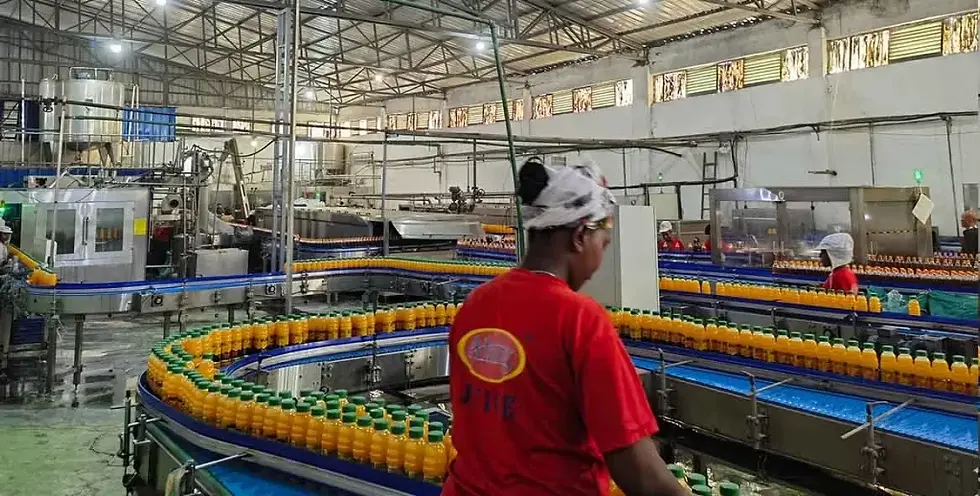
Juice Filling Machine: Production Line Process & Cost Guide
Updated: 6 days ago
A Complete Guide to Juice Beverage Production Lines, Filling Machines, Bottling Equipment and Turnkey Juice Factories
A juice production line is an integrated system used to process beverage ingredients, prepare the juice, sterilize or pasteurize the product, and fill it into PET bottles, glass bottles or cans. A complete juice production line can also include bottle making, rinsing, filling, capping, labeling, packaging and automated conveying.
For beverage manufacturers, choosing the right juice production line is not only about selecting a filling machine. The complete production process needs to match the juice formula, packaging type, production capacity, filling temperature, hygiene requirements and factory layout.
LiDLi Machinery provides customized juice beverage production solutions for PET bottle, glass bottle and can packaging, with production configurations designed around different beverage products and factory requirements. Its juice production solutions can reach capacities of up to 48,000 bottles per hour, while hot juice lines are available in configurations from approximately 3,000 to 36,000 bottles per hour based on 500 ml bottles. (Lidli Group)
Quick Specifications of a Juice Production Line
Parameter | Typical Configuration |
Main Products | Fruit juice, tea drinks, milk-based beverages, energy drinks, milk tea, coffee |
Packaging | PET bottles, glass bottles, cans |
Filling Technology | Hot filling, depending on product and package |
Capacity | From small-scale systems to high-speed industrial lines |
Hot Juice Line | About 3,000–36,000 bottles/hour based on 500 ml |
Overall Available Capacity | Up to 48,000 BPH |
Main Processes | Water treatment, ingredient preparation, mixing, sterilization, filling, capping/seaming, labeling and packaging |
Automation | Semi-automatic to fully automatic |
Project Type | Individual machine, production line or complete turnkey factory |
The exact capacity and configuration depend on the product, bottle or can size, filling temperature, viscosity, formula and required production output. (Lidli Group)
What Is a Juice Production Line?
A juice production line is a series of connected machines that converts water, juice concentrate, fruit ingredients, additives or other beverage ingredients into a finished packaged drink.
Unlike a single juice filling machine, a complete juice beverage production line covers multiple production stages. Depending on the product, the process may include:
Water treatment
Ingredient preparation
Juice blending and mixing
Heating or sterilization
Homogenization when required
Bottle or can preparation
Filling
Capping or can seaming
Cooling
Labeling
Secondary packaging
Conveying and finished-product handling
The actual process is not identical for every juice product. Clear fruit drinks, pulp-containing beverages, tea drinks, milk-based beverages and other formulations can require different preparation and filling systems.
This is why a juice production line should normally be designed around the product instead of selecting the largest filling machine first.
Why Is the Juice Production Line Important?
The filling machine is one of the most visible parts of a beverage factory, but production performance depends on the entire process.
An appropriately designed line can help manufacturers achieve:
Stable filling performance
Consistent product quality
Better production efficiency
Reduced manual handling
Better sanitation and cleaning
More efficient factory space utilization
Easier capacity expansion
Consistent bottle and package quality
For example, a high-speed filling machine cannot compensate for insufficient product preparation, inadequate sterilization or poorly designed conveyors. The production line needs to operate as one coordinated system.
For this reason, beverage factories normally evaluate the complete process from water and ingredients to the final packaged juice.
Types of Juice Production Lines
There is no single juice production line suitable for every beverage factory. The best configuration depends mainly on the beverage formula and the final package.
1. PET Bottle Juice Production Line
PET bottles are widely used for fruit juice and tea beverages because they are lightweight, easy to transport and suitable for high-volume production.
A typical PET bottle juice line can include:
Water treatment system
Ingredient preparation system
Mixing tank
Sterilization or heating system
Homogenizer when required
PET bottle blowing machine
Air conveyor
Bottle rinsing system
Juice filling machine
Capping system
Bottle cooling system
Labeling machine
Date coding system
Shrink packaging machine
Finished-product conveyor
LiDLi provides automatic PET bottle juice filling equipment for hot filling applications involving fruit juice drinks and tea beverages. The PET bottle system can also be integrated with bottle blowing and air conveying equipment for a more automated factory layout. (Lidli Group)
2. Glass Bottle Juice Production Line
Glass bottles are often selected when a beverage brand wants a more premium package or a traditional product presentation.
A glass bottle juice production line may contain:
Bottle washing and preparation equipment
Product preparation system
Heating or sterilization system
Glass bottle filling machine
Capping equipment
Bottle cooling system
Labeling machine
Secondary packaging equipment
Conveyor system
Glass bottle filling requires different bottle handling and filling configurations from PET packaging. The choice of bottle diameter, bottle height, cap type and filling temperature can therefore affect the final equipment configuration.
LiDLi offers automatic glass bottle juice filling solutions for hot-filled tea and fruit juice beverages. (Lidli Group)
3. Can Juice Filling Line
Canned juice is another option for beverage manufacturers who want an aluminum or metal container.
The main difference between a bottle filling line and a canning line is the container handling and sealing process.
A typical can juice line includes:
Water treatment
Juice preparation
Mixing and heating
Can depalletizing or can feeding
Can rinsing
Juice filling
Can seaming
Cooling
Coding
Packaging
Conveying
LiDLi's can juice filling and sealing equipment is designed for low-viscosity liquid products and can be configured for two-piece can applications. The listed equipment can reach up to 750 cans per minute depending on the specific configuration. (Lidli Group)
What Machines Are Used in a Juice Production Line?
A complete juice beverage production line is usually made up of several functional sections.
1. Water Treatment and Purification System
Water is one of the main components of many juice beverages, so water treatment is an important part of the production process.
Depending on the source water and product requirements, the treatment system may include:
Raw water tank
Sand filter
Carbon filter
Fine filtration
Membrane treatment
UV sterilization
Ozone treatment
Purified water tank
Water pumping and piping system
The exact water treatment configuration should be determined by the incoming water quality and beverage formula rather than using one standard system for every factory.
LiDLi's production-line configuration includes water treatment and purification equipment before beverage preparation and filling. (Lidli Group)
2. Juice Mixing and Preparation System
After water treatment, the beverage ingredients are prepared according to the product formula.
Depending on the product, the preparation section may include:
Mixing tanks
High-shear emulsifying tanks
Ingredient dosing systems
Syrup preparation
Juice blending tanks
Plate heat exchangers
Storage or buffer tanks
Different beverages require different preparation technologies.
A low-viscosity fruit drink does not necessarily need the same system as a pulp-containing beverage or milk-based drink.
3. UHT Sterilizer and Homogenizer
Some beverage products require high-temperature treatment and homogenization.
A typical system can include:
UHT sterilizer → homogenizer → buffer tank
The sterilization and homogenization requirements depend on the product formula and processing technology.
LiDLi lists UHT sterilization, homogenization and buffer tanks among the equipment that can be included in a complete beverage production solution. (Lidli Group)
4. CIP Cleaning System
CIP stands for Cleaning in Place.
A CIP system allows product-contact pipelines, tanks and process equipment to be cleaned without dismantling the entire production system.
A typical CIP station may include:
Cleaning solution tanks
Circulation pumps
Heating system
Piping
Valves
Flow meters
Temperature monitoring
Control system
LiDLi's listed CIP system includes flow monitoring and temperature control, with the page specifying temperature-control precision of approximately ±2°C. (Lidli Group)
5. PET Bottle Blow Molding Machine
For PET bottle factories, the empty bottle can be manufactured on site instead of purchased from an outside bottle supplier.
PET bottle blowing systems can be divided broadly into:
Semi-automatic bottle blowing machines
Fully automatic PET blow molding machines
An automatic bottle blowing machine can be connected to the filling line through an air conveyor, reducing manual bottle transportation and allowing the bottle production and beverage filling sections to operate as an integrated system.
LiDLi provides PET bottle blowing equipment for different bottle sizes and production speeds. (Lidli Group)
6. Juice Filling Machine
The juice filling machine is the central packaging machine in a bottled juice production line.
For bottle applications, a common configuration combines:
Bottle washing/rinsing + filling + capping
This type of 3-in-1 machine reduces manual operation and can improve the efficiency of the packaging section.
LiDLi's RCGF filling equipment is designed for hot filling applications involving fruit juice, green tea, black tea, oolong tea, energy drinks and dairy beverages. (Lidli Group)
7. Bottle Cooling System
After hot filling, the container may need controlled cooling before entering downstream packaging equipment.
A bottle cooling tunnel can provide:
Controlled cooling
Bottle temperature reduction
Continuous conveyor movement
Better integration with downstream labeling and packaging
LiDLi's listed bottle cooling tunnel uses spray-water cooling and stainless-steel construction, with an openable top design intended to make inspection and maintenance easier. (Lidli Group)
8. Labeling Machine
After filling and cooling, bottles can be sent to an automatic labeling machine.
Common labeling technologies include:
PVC shrink sleeve labeling
Self-adhesive labeling
OPP hot-melt labeling
The appropriate labeling machine depends on the selected label material, bottle shape and production speed.
9. Bottle Packaging Machine
The final packaging stage prepares finished bottles for storage and transportation.
Typical options include:
PE film shrink wrapping
Carton packaging
Tray packaging
Multipack packaging
The packaging format should be selected according to product positioning, logistics requirements and market expectations.
How Does a Juice Production Line Work?
The production process can be summarized as follows:
Water Treatment → Ingredient Preparation → Mixing → Sterilization → Homogenization → Buffer Tank → Bottle Preparation → Filling → Capping → Cooling → Labeling → Packaging
For a PET bottle production factory, the bottle process can be integrated as:
PET Preform → Bottle Blowing → Air Conveyor → Rinsing → Filling → Capping
For canned juice:
Can Feeding → Can Rinsing → Juice Filling → Seaming → Cooling → Coding → Packaging
The exact sequence changes according to the beverage formulation and packaging format.
Juice Production Line Process
Step 1: Water Treatment
Raw water is filtered and treated to produce process water suitable for beverage production.
Step 2: Ingredient Preparation
Fruit juice, concentrates, sugar, flavors, additives or other ingredients are prepared according to the recipe.
Step 3: Mixing
Water and beverage ingredients are mixed to obtain the target formulation.
Step 4: Heating or Sterilization
The product is treated using the required thermal process.
Step 5: Homogenization
For beverages that require improved dispersion or product consistency, homogenization can be used.
Step 6: Buffering
A buffer tank helps maintain a stable supply of beverage product to the filling machine.
Step 7: Container Preparation
PET bottles can be blown on site, while glass bottles and cans are supplied and prepared for filling.
Step 8: Filling and Sealing
The juice filling machine fills the beverage into the selected container, followed by capping or can seaming.
Step 9: Cooling
Hot-filled packages can pass through a cooling system before labeling.
Step 10: Labeling and Packaging
Finished containers are labeled, coded and packed for transportation.
Hot Filling vs. Other Juice Filling Technologies
Hot filling is commonly used for certain fruit juice and tea beverage products because the filling and thermal processing are designed together.
However, not every beverage requires exactly the same filling technology.
The correct choice depends on:
Factor | Why It Matters |
Beverage Formula | Determines processing and filling requirements |
Acidity | Influences thermal processing strategy |
Viscosity | Affects pump and filling design |
Pulp Content | Requires appropriate product handling |
Bottle Material | Determines container resistance and process design |
Filling Temperature | Affects bottle and cap selection |
Shelf-Life Target | Influences sterilization and packaging requirements |
Production Capacity | Determines machine size and line configuration |
This is one reason a professional supplier normally asks for product details before recommending a complete juice filling line.
How to Choose a Juice Production Line
Choosing the correct line starts with the beverage and factory requirements.
A practical selection process can use six main factors.
Factor | Key Question |
1. Product | What type of juice or beverage will you produce? |
2. Package | PET bottle, glass bottle or can? |
3. Capacity | How many bottles or cans per hour? |
4. Bottle Size | 250 ml, 350 ml, 500 ml, 1 L or another size? |
5. Process | Hot filling, UHT or another technology? |
6. Automation | Semi-automatic or fully automatic? |
For example, a factory producing 500 ml PET bottled fruit juice at medium capacity will need a different system from a premium glass-bottle juice factory or a high-speed canned beverage plant.
Small Juice Production Line vs. Large Juice Factory
A small beverage manufacturer may not need an extremely high-speed automated system.
A small juice production line can be designed around:
Lower initial investment
Smaller factory area
Fewer operators
Moderate production capacity
Flexible product changes
A large beverage factory may require:
High-speed filling
Automatic bottle blowing
Automatic conveying
Large-capacity product preparation
Automated CIP
Automatic labeling
Automatic secondary packaging
Centralized production-line controls
The correct solution is not necessarily the largest possible machine. The objective is to match production capacity with actual market demand and future growth.
Juice Production Line Cost
The price of a juice production line cannot be accurately determined from the filling machine alone.
The total project cost can include:
Water treatment system
Juice preparation system
Mixing tanks
Sterilization system
Homogenizer
CIP system
Filling machine
Bottle blowing machine
Cooling tunnel
Labeling machine
Packaging machine
Conveyors
Electrical control system
Installation
Factory utilities
Spare parts
Commissioning and technical support
A complete turnkey juice factory therefore costs substantially more than a single juice filling machine.
The price also changes according to capacity.
For example:
Small Capacity → Basic Production Equipment → Lower Investment
Medium Capacity → Automated Filling + Packaging → Medium Investment
High Capacity → Complete Automated Turnkey Line → Higher Investment
When comparing quotes from different juice production line companies, buyers should compare the complete scope of supply instead of comparing only the filling machine price.
What Affects the Price of a Juice Filling Line?
The major factors affecting juice filling machine and production line price include:
Production Capacity
A 3,000 BPH system and a 36,000 BPH system have very different equipment requirements.
Bottle Type
PET, glass and cans require different filling and container-handling equipment.
Filling Technology
Hot filling, aseptic processing, UHT-related processes and other technologies have different equipment requirements.
Automation Level
Fully automatic lines generally require additional conveyors, controls and packaging equipment.
Bottle Size
A line designed for several bottle sizes may require additional change parts and configuration.
Beverage Type
Clear juice, fruit drinks, tea drinks, milk beverages and products containing particles can require different processing systems.
Packaging
Shrink film, carton and other packaging formats influence the downstream equipment.
Turnkey Juice Production Line
A turnkey juice production line means that the supplier designs and integrates multiple production sections into one complete factory solution.
A typical A-to-Z project may include:
Water Treatment
↓
Juice Preparation
↓
Sterilization / Heating
↓
Homogenization
↓
Bottle Making
↓
Filling
↓
Capping / Seaming
↓
Cooling
↓
Labeling
↓
Packaging
↓
Finished Product Handling
LiDLi describes its solution as a turnkey fully automatic bottled juice filling production line and also provides customized liquid filling and packaging production lines for juice, water, carbonated beverages, milk, beer and edible oil applications. (Lidli Group)
Juice Production Line for Different Beverages
A well-designed beverage production factory can often be configured for multiple products.
Fruit Juice
Suitable for orange juice, mango juice, apple juice and other fruit-based beverages.
Tea Beverages
The same general production architecture can be configured for green tea, black tea and oolong tea drinks, depending on the processing requirements.
Energy Drinks
Requires product-specific mixing and filling parameters.
Milk-Based Beverages
May require homogenization and specialized thermal processing.
Milk Tea
Can require additional mixing and product preparation equipment depending on viscosity and formulation.
Coffee Drinks
The processing system is configured according to the specific coffee beverage formula and packaging format.
LiDLi's juice-production solution page specifically lists juice, tea, milk-based products, liquid foods, energy drinks, milk tea and coffee among the beverage applications it can serve. (Lidli Group)
PET Bottle, Glass Bottle or Can: Which Is Better?
There is no universally best package.
Packaging | Main Advantage | Typical Consideration |
PET Bottle | Lightweight and flexible | Suitable for high-volume beverage production |
Glass Bottle | Premium appearance | Heavier and requires careful bottle handling |
Can | Compact and convenient | Requires filling and seaming equipment |
The best choice depends on the beverage brand, target market, logistics, product positioning and required production capacity.
What Should You Ask a Juice Production Line Manufacturer?
Before requesting a quotation, prepare the following information:
Product:Fruit juice, juice drink, tea, milk beverage, energy drink or another product.
Package:PET bottle, glass bottle or can.
Bottle/Can Size:For example, 250 ml, 350 ml, 500 ml, 1,000 ml.
Target Capacity:For example, 3,000 BPH, 6,000 BPH, 12,000 BPH, 18,000 BPH or higher.
Filling Technology:Hot filling or another required process.
Number of Products:One product or multiple beverage formulas.
Factory Space:Available production and storage area.
Automation:Semi-automatic, automatic or fully automatic.
The more complete the information, the more accurately a supplier can design the production line.
Why Buy a Complete Juice Production Line Instead of Individual Machines?
Purchasing individual machines can look cheaper initially, but a complete production line offers several advantages.
A properly integrated line can provide:
Matched machine capacities
Coordinated conveyor speeds
Integrated control systems
Consistent product transfer
Easier installation
Simplified operation
Better production planning
One engineering partner for the complete project
This becomes particularly important for new beverage factories that do not already have an existing production system.
Frequently Asked Questions
What is a juice production line?
A juice production line is a complete system for preparing, processing, filling, sealing, labeling and packaging juice beverages.
What products can be made on a juice production line?
Depending on the configuration, the line can be designed for fruit juice, juice drinks, tea beverages, milk-based drinks, energy drinks, milk tea, coffee and other liquid beverage products. (Lidli Group)
Can juice be filled into PET bottles?
Yes. PET bottle juice filling machines are commonly used for bottled juice and tea beverages, and PET bottle blowing machines can be integrated with the filling line. (Lidli Group)
Can juice be filled into glass bottles?
Yes. Glass bottle juice filling machines can be configured for hot-filled fruit juice and tea beverages. (Lidli Group)
Can juice be filled into cans?
Yes. Can juice filling and seaming machines can be used for suitable low-viscosity beverage products. (Lidli Group)
What is the capacity of a juice production line?
Capacity varies by equipment configuration. LiDLi lists hot juice line capacities from approximately 3,000 to 36,000 bottles per hour based on 500 ml bottles, while its juice production solution page states production capacity up to 48,000 BPH. (Lidli Group)
How much does a juice production line cost?
There is no single fixed price. The final cost depends on capacity, bottle type, filling technology, processing system, automation level, packaging equipment and factory configuration.
Can a juice production line be customized?
Yes. Production lines can be customized according to beverage formula, container type, capacity, bottle size, factory layout and automation requirements.
How to Select the Right Juice Production Line Manufacturer
When comparing juice production line companies, do not evaluate suppliers only by the filling machine quotation.
Look at the complete engineering capability:
Product Processing
Can the supplier understand your beverage and process requirements?
Filling Technology
Can the supplier provide the correct filling solution for your container and product?
Complete Line Integration
Can the supplier connect water treatment, preparation, filling and packaging equipment into one system?
Capacity Matching
Are upstream and downstream machines properly matched?
Factory Layout
Can the supplier design a practical production flow according to your available space?
Technical Support
Can the supplier assist with installation, commissioning, operation and future upgrades?
These factors often matter more than the difference between two machine quotations.
Conclusion
A juice production line is much more than a juice filling machine. It is a complete beverage processing and packaging system connecting water treatment, ingredient preparation, mixing, thermal processing, filling, sealing, cooling, labeling and packaging.
For manufacturers producing bottled fruit juice, tea drinks or other liquid beverages, the right solution depends on the product formula, container type, required capacity, filling technology and factory layout.
PET bottles, glass bottles and cans each require different packaging systems, while small beverage factories and large industrial plants have very different automation and production requirements.
A well-designed turnkey juice production line should therefore be built around the actual product and production target rather than simply choosing the highest-speed filling machine.
LiDLi Machinery provides customized juice production and filling solutions for PET bottles, glass bottles and cans, with complete production-line configurations for different beverage applications and capacities. (Lidli Group)
For a juice production line quotation, the most useful information to provide is your beverage type, package, bottle or can size, target capacity and filling technology requirement.
Mango Juice Beverage Production Line
Orange Juice Beverage Production Line
Apple Juice Beverage Production Line
Pineapple Juice Beverage Production Line
Guava Juice Beverage Production Line
Passion Fruit Beverage Production Line
Coconut Juice Production Line
Coconut Water Filling Machine
Lychee Juice Beverage Production Line
Pomegranate Juice Beverage Production Line
Mixed Fruit Beverage Production Line
PET Juice Filling Machine
Glass Bottle Juice Filling Machine
Can Juice Filling Machine
Hot Filling Machine
Fruit Juice Beverage Production Line